Methodology

The Cyber Value Arc

A five-phase cybersecurity transformation methodology forged through years of enterprise engagements. It is how THORVIZ scopes, executes, and transitions every engagement.

The Arc · Five Phases
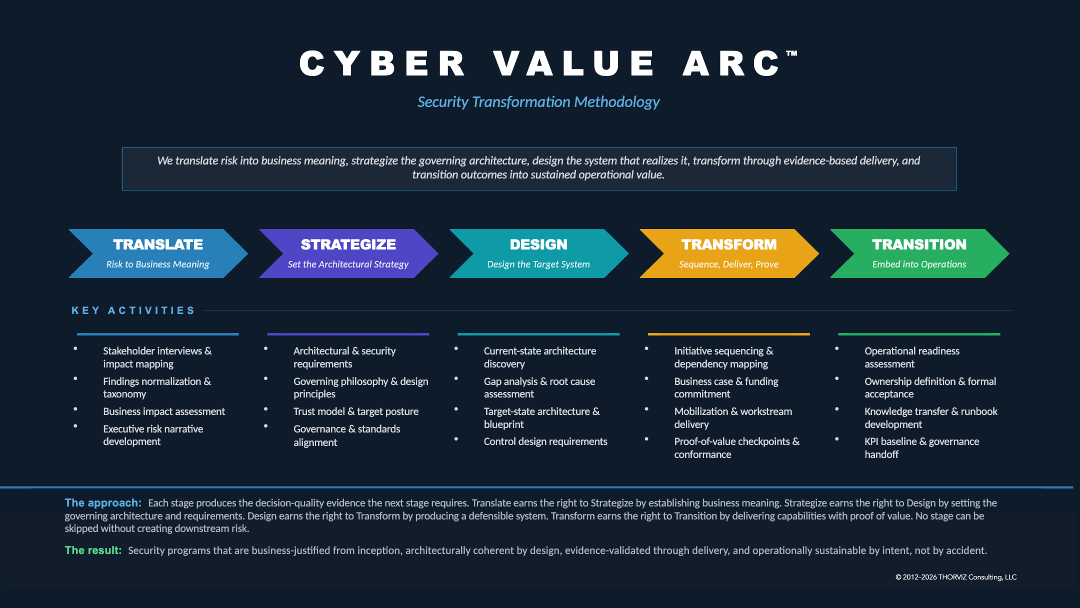
Cyber Value Arc — Security Transformation Methodology

Our Cyber Value Arc was forged in practice, not theory. When applied with discipline, security investments translate into measurable business outcomes — justified, delivered, and sustained.

The Five Phases

From ambiguity to operational reality.

Each phase produces specific, defensible outputs and closes a gap that many security programs leave open. Together, they form a continuous arc from business intent to sustained operational capability.

Phase 01

Translate

Risk to Business Meaning

Security initiatives fail at inception when they begin in control language rather than business language, or when they ignore the contextual realities that bound delivery. Translate reframes security and risk in terms executives can reason about. At the same time, it surfaces the constraints that shape what is achievable—capacity, timelines, organizational readiness, regulatory obligations, and other operational realities.

Together, these perspectives transform ambiguous concern into a decision-ready problem statement grounded in organizational reality.

This phase establishes both the business rationale and the operating context for everything that follows. Without it, strategy lacks a defensible foundation, design lacks clear intent, and execution inevitably encounters constraints that should have been recognized from the outset.

Key Outcomes
  • Risk translated into business impact and decision context
  • Stakeholder alignment on priorities, constraints, and success criteria
  • Decision-ready problem statement grounded in organizational reality
Phase 02

Strategize

Set the Architectural Strategy

A governing strategy established before design begins. Strategize converts business-framed risk into a deliberate architectural direction, defining the security requirements, trust model, target posture, standards alignment, and guiding principles that shape the engagement. It establishes the basis for balancing security objectives with operational constraints and scalability requirements, ensuring that architectural decisions are made within a consistent strategic context.

A fully articulated strategy then serves as the decision framework through which that context is applied. Rather than prescribing individual outcomes, it defines the risk tolerances, governance logic, and tradeoff criteria used to evaluate competing priorities over time. The result is an architecture that remains coherent and defensible as conditions, technologies, and business objectives evolve.

Key Outcomes
  • Governing strategy established before design begins
  • Architectural direction and security requirements aligned to validated risk
  • Decision principles and tradeoff criteria defined to govern the system lifecycle
Phase 03

Design

Design the Target System

A defensible target-state architecture, not a collection of controls. Design translates strategy into structure, defining the systems, identities, trust boundaries, and information flows through which security is realized. Rather than compensating for architectural weaknesses with additional controls, security is embedded as a property of the architecture itself.

Every design decision remains traceable to the governing strategy above it and the validated risk beneath it, producing a target state that is coherent, defensible, and implementable.

Key Outcomes
  • Defensible target-state architecture defined
  • Design decisions traced to strategy and validated risk
  • Implementation-ready design basis established
Phase 04

Transform

Sequence, Deliver, Prove

Transform converts architecture into measurable change. Work is sequenced into a dependency-aware roadmap with clear rationale for what happens now, next, and later. Delivery proceeds in increments that produce evidence of value as capabilities are realized, rather than relying on retrospective claims after implementation is complete.

Pace is governed by organizational capacity, not ambition. Architectural drift and delivery risks are continuously identified and corrected throughout execution.

Key Outcomes
  • Funded, sequenced transformation roadmap
  • Capabilities delivered with evidence of value
  • Execution maintained in alignment with strategy and design
Phase 05

Transition

Embed into Operations

A security capability that cannot be operated is a capability that will quietly decay. Transition closes the engagement arc through ownership transfer, operational enablement, governance integration, and a defined model for continuous improvement.

The engagement ends. The capability continues.

Key Outcomes
  • Clean ownership transfer to operations
  • Sustainable governance integrated into steady-state operations
  • Continuous improvement path established
System Integrity
Security programs often fail to deliver promised outcomes not because individual activities are executed poorly, but because the connection between business intent, architectural decisions, delivery execution, and operational ownership breaks down.

The Cyber Value Arc preserves that connection. Each phase produces the inputs required by the next, forming a continuous chain from business-framed risk to operationally sustained capability. The result is security transformation that is justified before it is funded, governed before it is designed, validated as it is delivered, and sustained long after the engagement concludes.

It is the codified discipline behind this outcome. It governs how THORVIZ translates intent into value through engagements, structures execution, and defines completion.